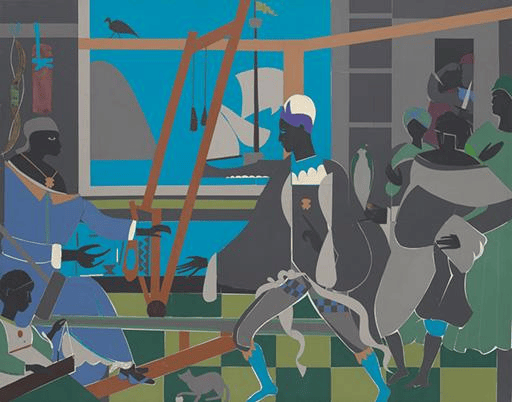
Romare Bearden’s 1977 Black Odyssey begins with Homer, but its most important question reaches far beyond Homer. In his series of collages based on The Odyssey, Bearden reimagines Odysseus, Penelope, Circe, the Cyclops, and the Mediterranean world through Black figures and an artistic vocabulary shaped by African, African American, Caribbean, and modernist traditions. At first glance, his intervention might appear to be about representation: Bearden places Black people inside one of the foundational stories of the Western canon. But I think the deeper significance of Black Odyssey lies elsewhere. Bearden forces us to ask a more difficult question: Who inherits civilization?
My answer is that civilization belongs neither to its creators nor to its custodians alone. It also belongs to its interpreters. That distinction matters because Bearden is not arguing that Odysseus was historically Black or that ancient Greece should simply be recast according to modern racial categories. Such an argument would make his work much less interesting. Instead, Bearden leaves the basic architecture of Homer’s story intact while changing the visual language through which we encounter it. Odysseus still wanders. Penelope still waits. The hero still confronts danger, temptation, death, memory, and the longing for home. What changes is our expectation of what that story is supposed to look like. In The Return of Odysseus (Homage to Pinturicchio and Benin), that transformation is especially visible where Bearden draws upon an Italian Renaissance representation of Odysseus while incorporating physical features inspired by Benin masks and sculpture. European and African artistic inheritances occupy the same classical image.
That disruption exposes something important about Classics. For centuries, European societies did not merely preserve Greece and Rome. They repeatedly interpreted them. Romans absorbed Greek culture. Medieval Christian thinkers incorporated pagan philosophy. Renaissance Europeans reconstructed classical antiquity according to their own intellectual and artistic worlds. British and American institutions later turned Greece and Rome into foundations of what they called Western civilization. None of these groups simply inherited antiquity unchanged. They translated it, selected from it, reorganized it, and made it speak to their own circumstances.
Why, then, should Black people be treated differently? Bearden’s answer is striking because he does not ask permission to enter the classical tradition. He behaves as though Homer already belongs to him. That may be the most radical thing about Black Odyssey. The question, therefore, is not whether Black people can somehow be “included” within Classics. Inclusion still assumes that someone else owns the room and possesses the authority to open the door. Bearden suggests another possibility: perhaps the classical tradition is part of a broader human inheritance, available to anyone willing to encounter it seriously enough to interpret and transmit it. His choice of collage makes this argument even more powerful. Bearden constructs images from fragments: different textures, colors, forms, traditions, and visual sources placed together to make something new. Civilization works in much the same way. Cultures borrow, inherit, reinterpret, remember, forget, and reconstruct. What we now call “Western civilization” is itself a collage created through centuries of exchange among Africa, the Mediterranean, Europe, the Near East, and eventually the Americas.
Civilization survives not because it remains culturally pure, but because people keep reassembling its pieces. That is precisely what Bearden does with Homer. The idea of inheritance also changes how we understand Odysseus’s journey home. The Odyssey is, among many things, a story about displacement. Odysseus spends years trying to return to Ithaca. Bearden places that ancient longing beside the experience of the African diaspora, where displacement and the search for home carry enormous historical meaning. Bearden makes that idea especially explicit by placing a Black Odysseus upright at the bow, arriving almost triumphantly. He inherits the episode rather than merely reproducing it.
But Bearden’s work raises another question that I find especially important: What happens when someone is told that the civilization they are studying is not their intellectual home? For generations, Black students encounter a classical world presented largely as someone else’s cultural inheritance. Greece and Rome appear as European possessions, even though the ancient Mediterranean itself was far more complicated than modern racial categories suggest. A Black student studying Homer is therefore sometimes imagined as a visitor to the Western canon rather than one of its possible heirs. Bearden reverses that relationship. His Black Odysseus is not standing outside Homer, asking to be admitted. He is already sailing through Homer’s sea.
That makes Black Odyssey particularly meaningful to my own inquiry into who gets access to civilization and, ultimately, who gets to decide. Museums, universities, textbooks, scholars, and cultural institutions have enormous power because they do more than preserve history. They determine which histories become familiar, which interpretations appear authoritative, and which people are encouraged to recognize themselves within civilization’s story. Bearden demonstrates that those decisions can be challenged through interpretation. This is why his work belongs in a larger conversation about collective memory. When generations of paintings, films, museums, and textbooks repeatedly imagine classical figures through European bodies, those images begin to feel historically inevitable. We forget that someone created the visual vocabulary through which we learned to imagine antiquity. Bearden changes that vocabulary. By doing so, he does not erase Homer. He makes us see how much has already been added to Homer by everyone who came before him. That is why I see Black Odyssey not simply as a work about Black representation in Classics, but as a declaration about cultural inheritance.
Bearden shows that civilization cannot remain the exclusive property of those who first created it or of the institutions that later appointed themselves its guardians. A civilization remains alive because new generations encounter it, argue with it, reinterpret it, and pass it forward. Bearden inherited Homer by transforming Homer. And perhaps that is what inheritance has always meant.
Sources & Further Reading:
National Gallery of Art, Home to Ithaca and educational materials on Bearden, migration, and displacement.
Homer, The Odyssey, particularly the episodes of Odysseus’s wandering and return to Ithaca.
Robert G. O’Meally, Romare Bearden: A Black Odyssey.
The Art Institute of Chicago, The Return of Odysseus (Homage to Pinturicchio and Benin) (1977).
 Classical Mosaic
Leave a comment