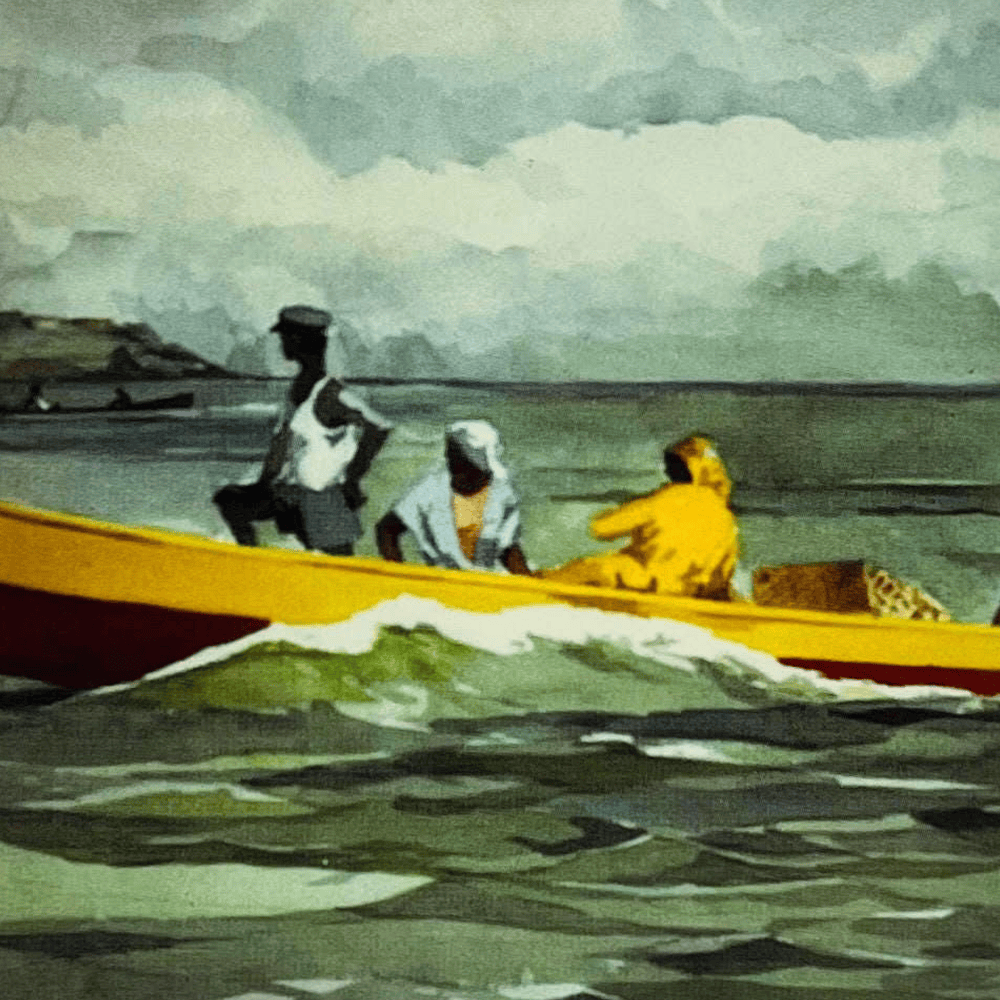
I am African American on both sides of my family, with roots in the United States extending back more than five generations. I was born in New York City, a place that has always been home. But during the COVID-19 pandemic, my family decamped from New York to Saint Lucia, and for an adventurous period in my life, the island became home too. It was there, on an island whose mountains rise dramatically from the Caribbean Sea and whose history carries the marks of Africa, Europe, slavery, empire, and independence, that I first discovered Derek Walcott. Reading Omeros after having lived in Saint Lucia changed the way I understood Homer. Walcott was not simply borrowing from the classical tradition. He was making a claim upon it.
That claim reminds me of Romare Bearden’s Black Odyssey, but the two artists ask slightly different questions. Bearden asks: Who may enter the story? Walcott asks: Who may inherit it?
In Black Odyssey, Bearden takes Homer’s ancient Greek epic and visually reimagines it through Black figures, African diasporic imagery, and the visual language of collage. Odysseus, Penelope, Circe, and Poseidon remain recognizable, but the world they occupy has changed. Black people are no longer standing outside the classical tradition looking inward. Bearden places them inside it.
That gesture is more radical than it initially appears. For generations, Western institutions treated Greece and Rome as the foundation of European civilization and, by extension, as cultural property guarded by particular schools, museums, universities, and scholars. People of African descent could study the classics, perhaps, but they were rarely represented as natural inheritors of them. Bearden disrupts that assumption. His figures do not ask permission to appear in Homer. They simply inhabit the story.
But Walcott takes the argument one step further. In Omeros, Homer does not merely become a story in which Black people enter. Homer becomes material that Caribbean people transform, reinterpret, and ultimately possess as part of their own cultural inheritance. Walcott names his Saint Lucian characters Achille, Hector, Helen, and Philoctete, deliberately invoking the Iliad and Odyssey. Yet these are not Greek warriors transported to the Caribbean. Achille and Hector are fishermen. Helen is a Saint Lucian woman. Philoctete suffers from a physical wound that also symbolizes the historical injuries of slavery and colonialism. The Homeric names matter, but Walcott refuses to let them control the meaning of his characters. That reversal is essential. Achille does not become significant because he resembles Achilles. Instead, Achilles becomes newly available for interpretation because Achille exists.
Walcott therefore changes the relationship between the classical world and the descendants of colonized peoples. The question is no longer whether a Caribbean writer can legitimately use Homer. Walcott assumes that right from the beginning. His deeper question is what happens to civilization when the people once positioned at its margins begin interpreting its foundational texts for themselves. Achille’s journey captures this most powerfully. Like Odysseus, he is searching for home, but his problem is different. Odysseus knows where Ithaca is. Achille inherits the rupture of the Middle Passage. His ancestors were separated from Africa, their languages, names, and histories violently interrupted. When Achille encounters Afolabe in Book III, he describes that rupture through language itself: “The deaf sea has changed around every name that you gave us.” The loss is therefore not only geographic. The Middle Passage has interrupted the connection between names, ancestry, place, and memory.
When Achille imaginatively journeys back to Africa, he confronts something Homer never had to confront: what does returning home mean when history has destroyed the road back? Walcott’s answer is not that Achille should simply recover an African identity untouched by history. In fact, when Afolabe presses Achille to recover the meaning of his name, Achille explains that in his world “we accept the sounds we were given.” It is an uncomfortable answer, but an important one: Walcott refuses to pretend that historical rupture can simply be reversed. Nor does he suggest that Caribbean identity is merely a colonial inheritance from Europe. Instead, Saint Lucia itself becomes home: a place created from collision, survival, memory, and reinvention.
That insight changes what inheritance means. Inheritance is usually imagined as something passed intact from one generation to another. Walcott shows that civilization does not work that way. Traditions travel. They fracture. They are imposed, resisted, remembered, forgotten, and remade.
I think this is why discovering Walcott in Saint Lucia mattered so much to me. I arrived on the island as an African American girl from New York. I was not Saint Lucian by ancestry. Yet for a strange and unforgettable period created by the pandemic, Saint Lucia became part of the geography of my own childhood. Later, encountering Omeros changed how I understood the classical tradition. Homer suddenly seemed less like a monument belonging to a distant ancient world and more like a language people could use to understand their own histories.
That is where Bearden and Walcott meet. Bearden asks whether people traditionally excluded from the visual imagination of Western civilization may enter its foundational stories. His answer is unmistakably yes.
Walcott asks the more difficult question that follows: once we enter those stories, must we continue telling them according to the terms established by their traditional custodians?
His answer is no. Civilization belongs neither solely to those who created it nor to those who later appointed themselves its guardians. It also belongs to those who inherit its fragments, reinterpret its meanings, and carry it somewhere its creators could never have imagined.
Bearden opens the door. Walcott walks through it, takes Homer with him, and brings him home to Saint Lucia.
Sources & Further Reading:
- Derek Walcott, Omeros (1990), especially Book III, Chapters XXV and XXXI.
- Homer, The Odyssey, especially Book 24 and the reunion of Odysseus and Laertes.
- Rachel D. Friedman, Derek Walcott’s Encounter with Homer: Landscape, History, and Poetic Voice in Omeros (Oxford University Press, 2024).
- Derek Walcott, “Achille in Africa,” an excerpt from Omeros originally published in AGNI.
 Classical Mosaic
Leave a comment